
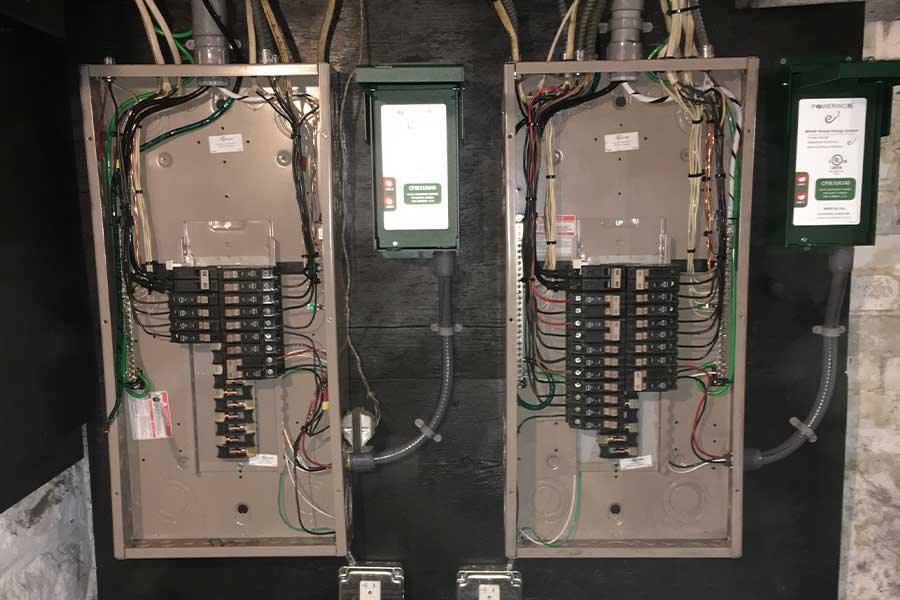
Whole-home surge protection in San Antonio guards every circuit in your house against voltage spikes from lightning, grid switching, and appliance cycling. Installed at the main electrical panel, it shields hardwired equipment that power strips cannot reach, including HVAC systems, water heaters, and ovens, for a fraction of what replacing them costs.
San Antonio’s storm season is one of the most active in Texas. Between the fast-moving thunderstorms that build along the Balcones Escarpment, the grid fluctuations that follow severe weather, and the everyday voltage irregularities that occur during high-demand summer afternoons, the electrical system in a San Antonio home takes more abuse than most homeowners realize. Add in the heat load that runs air conditioners nearly nonstop from May through September, and you have a grid that cycles hard and a house full of equipment sitting directly downstream of it.
This guide covers why surge protection matters in the San Antonio area, how the equipment works, what it actually protects, what it costs, and the common misconceptions that lead homeowners to underestimate its value.
Why Whole-Home Surge Protection Is Essential for San Antonio Homes
Power surges are not limited to lightning strikes. A direct or nearby lightning hit can send a destructive voltage spike through an electrical system in a fraction of a second, but the more common causes of surge damage are far less dramatic and far more frequent.
Major appliances cycling on and off, utility switching operations during peak demand, grid restoration after an outage, and even neighbors sharing the same pad-mount transformer can all introduce voltage irregularities that travel into a home through the electrical panel. These smaller events, often called transients, last only microseconds. You will not see the lights flicker. But over months and years, they degrade the sensitive circuit boards inside modern appliances until something fails on a day that seems completely unrelated to weather.
Our licensed San Antonio electricians see the aftermath most often in the weeks following a round of severe weather along the I-10 and Loop 1604 corridors, and again in late summer when demand on the grid peaks. Homes in newer Stone Oak and Hill Country subdivisions are just as exposed as older properties inside Loop 410, because the risk follows the utility feed and the density of electronics inside the house, not the age of the neighborhood.
A whole-home device addresses the problem at the source. Rather than relying on individual power strips scattered around the house, the protector installs at the main electrical panel and intercepts voltage spikes before they reach any circuit. It is the most comprehensive form of surge defense available for a residential property.
How Does Whole-Home Surge Protection Safeguard Appliances and Electronics
Working in homes across San Antonio, the pattern we run into repeatedly is the same. A power event damages an appliance or piece of electronics, and the homeowner either did not know whole-home protection existed or assumed the power strips behind the TV were doing the job.
The gap between a basic power strip and a panel-mounted system is significant. Consumer-grade strips provide limited protection at a single outlet location. A whole-house surge protector installation protects every circuit at once, including the hardwired equipment that never touches an outlet.
Inside the device, metal oxide varistors, commonly called MOVs, sit ready to divert excess voltage to the ground conductor the moment line voltage climbs past a safe threshold. The specification that matters most is the voltage protection rating, which describes how much voltage the device lets through before it clamps. A quality residential unit built to the current UL 1449 standard typically clamps in the 600 to 700 volt range on a 120 volt circuit, which is well below the level that damages appliance control boards.
Here is what that protection covers in a typical San Antonio home.
- Hardwired equipment. Outdoor condensing units, furnace and air handler control boards, tankless water heaters, ovens, dishwashers, and garbage disposals all connect directly to the electrical system. No power strip protects any of them.
- Smart home infrastructure. Thermostats, video doorbells, security panels, garage door openers, and Wi-Fi access points run on low-voltage boards that fail early under repeated transient stress.
- EV charging equipment. A Level 2 charger is a hardwired 240 volt circuit and a significant investment. It belongs on the protected side of the panel.
- Entertainment and office electronics. Televisions, computers, network switches, and gaming systems remain plugged into outlets, and a panel-mounted device shields the circuits feeding them.
The practical benefits break down into four areas.
Extended appliance lifespan. Equipment that is not repeatedly hammered by voltage irregularities reaches its expected service life instead of failing years early. This matters most for air conditioning systems in a climate where the compressor and blower run for the better part of eight months.
Lower repair and replacement spending. Surge damage to a refrigerator, an HVAC control board, or a home theater system runs into hundreds or thousands of dollars. Protection that costs a fraction of one of those repairs is straightforward math.
Reduced fire risk. Electrical arcing caused by voltage irregularities is a contributing factor in residential electrical fires. Suppressing those transients reduces both the frequency and the severity of arcing inside panels, junction boxes, and appliance wiring.
Whole-system coverage. A surge does not choose a circuit. Panel-level protection covers the entire load center at once rather than leaving the circuits you did not think about exposed.
How Much Does Whole-Home Surge Protection Cost in San Antonio
The financial argument holds up well when the numbers are laid out honestly.
A professionally installed whole-home surge protection device is a modest expense relative to what sits behind it. Typical residential installations land in the range of a few hundred dollars for the device plus labor, with higher-capacity units and panels that need additional work costing more. Compare that against what a single surge event can take out.
- An HVAC control board replacement, plus the diagnostic and labor time to get to it
- A refrigerator with an integrated inverter board
- A tankless water heater control module
- A full home entertainment or home office setup
Any one of those exceeds the cost of protection. A home carrying all of them is protecting tens of thousands of dollars in equipment.
Beyond direct equipment protection, many homeowners insurance carriers recognize the risk-reduction value of a panel-mounted system and offer premium consideration for homes that have one installed. Documentation from a licensed installation supports that conversation with your insurer, which is one more reason the work belongs on a permit and an invoice rather than in a weekend project.
There is also a resale angle. As smart home technology, EV chargers, heat pumps, and induction ranges become standard in San Antonio and Boerne area properties, a documented surge protection system reads to informed buyers as evidence that the electrical system has been maintained deliberately.
What Happens During a Whole-Home Surge Protector Installation
This is a professional electrical installation, not a plug-in product. The device connects directly to the main electrical panel, where it monitors incoming power and shunts voltage events to ground before they reach any downstream circuit. That connection point is what gives the system its reach, and it is also why the work requires a licensed electrician and, in most jurisdictions around Bexar County, a permit and inspection.
A proper installation includes four stages.
- System assessment. The existing panel is evaluated to confirm compatibility, verify the grounding and bonding are sound, and identify the shortest practical connection point. Long lead wires reduce a surge protector’s effectiveness, so placement is not arbitrary. Panels with corrosion, double-tapped breakers, or known-defective bus designs get flagged at this stage.
- Device selection. Protectors are not rated equally. Selection depends on the home’s service size, the surge current capacity measured in kiloamps, the voltage protection rating, and whether the unit carries a connected equipment warranty. A technician should be able to explain each of those in plain terms and tell you why a specific model fits your panel.
- Installation at the panel. The device is mounted, connected on a dedicated double-pole breaker, and properly bonded. This is the step that separates a whole-home system from a strip-style protector and what allows it to cover every circuit in the house simultaneously.
- Testing and verification. The unit is tested and the status indicator confirmed. Most quality devices include a green indicator light, and some include an audible alarm that signals when protection capacity has been spent. You should leave the appointment knowing what was installed, how it works, and what the indicator is telling you.
If your panel is aging, undersized for the loads you have added, or has not been evaluated in the last decade, an electrical panel upgrade or replacement assessment is worth scheduling alongside the surge protection work. A protector depends on a solid ground path to do its job, so it performs best on a panel that meets current capacity and safety standards.
Common Myths About Surge Protection Worth Addressing
A few misconceptions consistently lead homeowners to skip protection entirely or rely on inadequate substitutes.
“I only need it during thunderstorm season.” Lightning is one source of surge events, and not the most common one. Transients from appliance cycling, grid switching, and utility operations happen year-round, including on the calm 100 degree afternoons when air conditioning demand peaks across the region. This is permanent infrastructure, not a seasonal precaution.
“My power strips are enough.” Consumer strips cover one location and nothing else. They do nothing for the condenser outside, the water heater in the garage, or the oven in the kitchen. A panel-mounted system is a categorically different level of coverage, not a stronger version of the same thing.
“A surge protector is a one-time purchase.” These devices absorb energy every time they respond, and that capacity diminishes over time. A unit that has weathered several significant events should be evaluated and eventually replaced, which is why the status indicator matters. A licensed electrician can check the condition of an existing device during a routine electrical repair or inspection visit.
“Surge protection means zero risk.” Panel-level protection dramatically reduces the risk and severity of surge damage. It does not eliminate every electrical risk, and an extremely close or direct lightning strike can overwhelm any system. The value is in a substantial reduction of risk, not an absolute guarantee, and pairing the panel device with point-of-use protection at your most sensitive electronics closes most of the remaining gap.
Frequently Asked Questions About Surge Protection in San Antonio
Does a whole-house surge protector protect appliances from lightning?
It protects against the far more common indirect effects of lightning, meaning the voltage spike that travels through utility lines after a strike hits nearby. A direct strike to the home or service drop can overwhelm any residential device. That is why we recommend panel protection as the foundation, with point-of-use protection at high-value electronics.
How long does a whole-home surge protector last?
Service life depends on how many events the device absorbs rather than the calendar. Many units last several years in average conditions, but a home that has taken repeated hits can spend that capacity much faster. The status indicator light is the reliable signal, and it should be checked during any routine electrical service visit.
Can I install a whole-home surge protector myself?
No. The device wires directly into the main panel behind the service disconnect, which means working near energized bus bars carrying full utility voltage. That work requires a licensed electrician, and in most Bexar County jurisdictions it requires a permit and inspection. Improper bonding also renders the protector largely ineffective even when it appears installed correctly.
Will a surge protector help with brownouts or low voltage?
Not directly. Surge protection devices respond to voltage spikes above a set threshold, not to sags or extended low-voltage conditions. Brownouts damage motors and compressors through a different mechanism, and equipment-level protection such as a hard start kit or voltage monitor is the right tool for that specific problem.
Do I still need power strips if I have whole-home protection?
Yes, for your most sensitive equipment. Layered protection is the standard approach. The panel device handles the large incoming spikes, and quality point-of-use protectors at computers, televisions, and network equipment catch the smaller residual voltage that gets past the first stage plus anything generated inside the home.
Protecting Your San Antonio Home’s Electrical Investment
Deciding whether whole-home surge protection is worth it comes down to a simple question. How much equipment in your house depends on a circuit board, and what would it cost to replace it? For most San Antonio homes, the honest answer is far more than the protection costs. Between the storm exposure along the escarpment, the summer demand cycles on the grid, and the steady march of electronics into every room, whole-home surge protection in San Antonio has become one of the highest-value upgrades available at the panel.
Hunter Service Group has served San Antonio and Boerne homeowners since 2015. As a family-owned and operated company, we bring honest guidance and licensed expertise to every electrical project. We will never recommend a product or service you do not need, and we treat every home we enter with the same respect we would want for our own, floor protectors and all.
When you are ready to protect your electrical system and everything connected to it, contact our team today to schedule a surge protection consultation.