
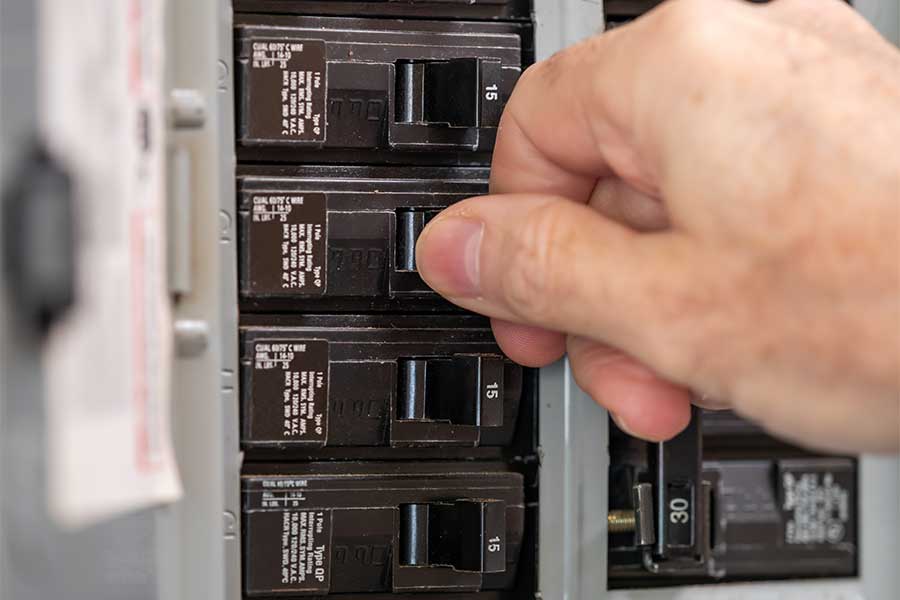
Recurring electrical problems in Helotes homes almost always trace back to one of five things. Circuits carrying more load than they were designed for, wiring that has aged past its service life, failing connections at outlets and switches, a panel that has run out of capacity, or weather stress on the system. Each has a clear fix.
Helotes sits at the edge of the Texas Hill Country, where aging housing stock, punishing summer heat, and volatile storms combine to put real strain on residential electrical systems. From the established neighborhoods along Bandera Road to the newer developments spreading toward the Bexar and Medina county line, the homes we work in show a consistent pattern of issues, and nearly all of them are preventable with the right attention.
Understanding what is actually causing the problem is the first step toward fixing it rather than resetting it. Our licensed Helotes electricians diagnose these systems every week, and the symptoms below rarely mean what homeowners assume they mean.
What Causes Flickering Lights and Tripping Breakers in Helotes Homes
Homeowners tend to describe the symptom. An electrician works backward from the symptom to the root cause, because the same flicker can come from four completely different problems. Here is how those causes present in the field.
Overloaded circuits
This happens when the combined demand of everything running on a single circuit exceeds what that circuit is rated to carry. Modern households run far more electronics, appliances, and HVAC equipment than older residential systems were ever designed for, and a home built in an earlier era may have half the circuit count a comparable new build would get today.
How it shows up. Breakers that trip when several things run at once, lights that dim when a large appliance kicks on, and in persistent cases, warm wiring and heat damage at outlets. A breaker that trips once under an unusual load is doing exactly its job. One that trips repeatedly under normal use is reporting a real problem.
Aging or deteriorated wiring
Insulation on older wiring becomes brittle with decades of heat cycling, which raises the risk of exposed conductors. Connections at junction boxes, receptacles, and the panel loosen over the same period for the same reason.
Homes in Helotes built in the early 1970s or before may also contain aluminum branch circuit wiring, which expands, contracts, and oxidizes differently than copper and has a documented history of connection failure at terminations. If your home dates to that era and the wiring has never been professionally evaluated, that assessment should be on the list.
How it shows up. Intermittent outlets, persistent flicker on specific circuits, and often nothing visible at all until an inspection opens a device box.
Failing outlets, switches, and connections
Devices wear out. Receptacles lose their grip on plug blades, terminal screws back off, and switches develop internal resistance.
How it shows up. Outlets that work sometimes and not others, switches that need to be jiggled, sparking at the moment of plug-in, and warmth at a cover plate. That last one deserves emphasis. An outlet or switch plate that is warm during normal use is never acceptable and is not something to monitor for a while.
Insufficient panel capacity
A panel that was adequate for a home’s original build often cannot support what has been added since, including newer HVAC equipment, EV charging, a shop, a pool, or a kitchen full of modern appliances.
How it shows up. Frequent trips across multiple circuits, warm breakers, breakers that will not stay set, and a panel with no open slots left for new circuits. Some older panels also carry known reliability concerns that an electrician can identify on sight.
Utility side and grid events
Not every problem is inside the house. A brief flicker during a storm may simply be a grid event, and neighborhood-wide symptoms point away from your wiring.
How it shows up. Flicker that affects the whole street, or that coincides with weather. If it is happening only in your home, or only on certain circuits, the cause is on your side of the meter.
How Texas Weather Affects Helotes Electrical Systems
The Hill Country climate stresses electrical systems in ways specific to this region.
Summer heat. Extended air conditioning runtime pushes residential systems near capacity for months at a stretch. Circuits that are marginally adequate in April start failing in July, and sustained heat accelerates insulation breakdown in older wiring, which compounds the aging problem.
Thunderstorms and lightning. Nearby strikes create direct surge risk, and grid fluctuation during weather events produces voltage irregularities that travel into the home through the panel. Those surges damage electronics, HVAC control boards, and appliances throughout the house. A whole-house surge protector installation at the main panel intercepts these events before they reach any downstream circuit, which makes it one of the more straightforward protective measures available to a Helotes homeowner.
Moisture and condensation. Humidity swings affect outlets, junction boxes, and wiring in garages, crawl spaces, and exterior walls where vapor management is imperfect. Moisture intrusion accelerates corrosion at connections and raises the risk of arcing.
High winds. Hill Country storms bring down limbs and trees that can damage the service entrance where utility conductors connect to the home. Visible damage to the weatherhead or service conductors after a storm warrants a call to both the utility and a licensed electrician before the system is used normally.
When Should You Call an Electrician Right Away
Some symptoms need same-day attention. Others can wait for the next available appointment. Knowing the difference matters, because treating an urgent symptom as routine is how small problems become fires.
Call immediately and stop using the circuit:
- Any burning smell coming from an outlet, a wall, or the panel
- Outlets or switch plates that are warm or hot to the touch
- Visible sparking at any outlet, switch, or fixture
- A breaker that trips again the instant it is reset
- Discoloration or scorch marks around any electrical device
These conditions indicate an active fault, and they are the reason we keep an emergency electrician available rather than asking homeowners to wait it out.
Schedule an evaluation at your convenience:
- Lights that flicker or dim without an obvious cause
- Breakers that trip repeatedly under ordinary household use
- Outlets in multiple locations that have stopped working
- A panel more than 20 years old that has never been professionally inspected
- Planned additions of high-load equipment such as an EV charger, hot tub, workshop, or additional HVAC unit
When a symptom does not clearly fit either list, treat it as urgent. Electrical faults do not resolve on their own, and the cost of an unnecessary service call is trivial next to the alternative.
Preventative Steps That Protect Your Electrical System
Most of what keeps a system healthy is unglamorous and inexpensive compared to what it prevents.
- Put inspections on a schedule. For homes over 20 years old, or any home that has never had a professional evaluation, a licensed electrician can identify developing wiring issues, overloaded circuits, and panel concerns while they are still cheap to correct. This is the single highest-value item on the list.
- Act on panel warning signs instead of working around them. An electrical panel upgrade or replacement is warranted when a panel runs consistently at capacity, when breakers are failing, or when the equipment itself has known safety concerns. Deferring necessary panel work raises both the risk and the eventual price.
- Plan capacity before you add load. Bringing an electrician in before installing an EV charger, hot tub, or second HVAC system is far simpler than discovering mid-project that the service cannot support it.
- Distribute load thoughtfully. In older homes with limited circuit counts, being aware of what shares a circuit reduces heat buildup and nuisance tripping. Where the layout genuinely cannot support the household, adding circuits is the permanent answer rather than a habit of unplugging things.
Frequently Asked Questions About Electrical Problems in Helotes
Why do my lights flicker when the air conditioner turns on?
A brief dip when a large motor starts is normal, since the compressor draws a surge of current at startup. Pronounced or lasting flicker is not normal and usually points to a loose connection, undersized service, or a circuit under strain. If it has gotten worse over time, have it evaluated.
How old is too old for an electrical panel?
Age alone is not the deciding factor, but panels past 25 to 30 years deserve a professional look. What matters more is capacity, the condition of the breakers and bus, and whether the panel is a make with documented safety concerns. An electrician can assess all three in a single visit.
Is it safe to keep resetting a breaker that trips?
No. A breaker that trips repeatedly is protecting the circuit from a real condition, whether that is overload, a short, or a ground fault. Resetting it over and over defeats the protection without addressing the cause. Repeated tripping under normal use needs a diagnosis.
Can I fix a bad outlet myself?
Replacing a receptacle looks simple and frequently is not, particularly in older homes where the wiring type, grounding, and box condition all affect what device is appropriate. Incorrect work at a termination is a common cause of the exact overheating problems described above, and it is licensed work for good reason.
How often should a home have an electrical inspection?
Every three to five years is a reasonable cadence for most homes, sooner for properties over 40 years old or homes that have recently added significant load. An inspection is also worth scheduling before buying a home, before a major remodel, and after any storm that damaged the service entrance.
Keeping Your Helotes Home’s Electrical System Safe and Reliable
Frequent electrical problems are a signal, not something to live with. If you take one framework from this guide, make it this. Anything you can smell, feel as heat, or see as a spark is urgent. Anything that is merely annoying and repeating is a scheduled diagnosis. And anything you are planning to add to the system should be discussed before the equipment arrives, not after.
Hunter Service Group has served Helotes homeowners and the broader San Antonio area since 2015. As a family-owned and operated electrical contractor, we bring honest assessments and licensed expertise to every service call. We will never recommend work that is not genuinely needed, and our technicians treat every home with the same care they would want for their own.
If your Helotes home is dealing with recurring electrical issues or has not had a professional inspection in years, contact our team today to schedule a service visit.